Skip to content

The payer said no.Send back proof.

Upload a denied claim and the patient's chart. ClaimDoc builds the complete appeal: the payer's form, a letter that answers every reason for the denial, and the pages that prove it. Checked, signed and ready to send in minutes.

Free to start, no card. Medicare, Medicare Advantage and commercial plans. Built for physical therapy clinics and the billers who serve them.

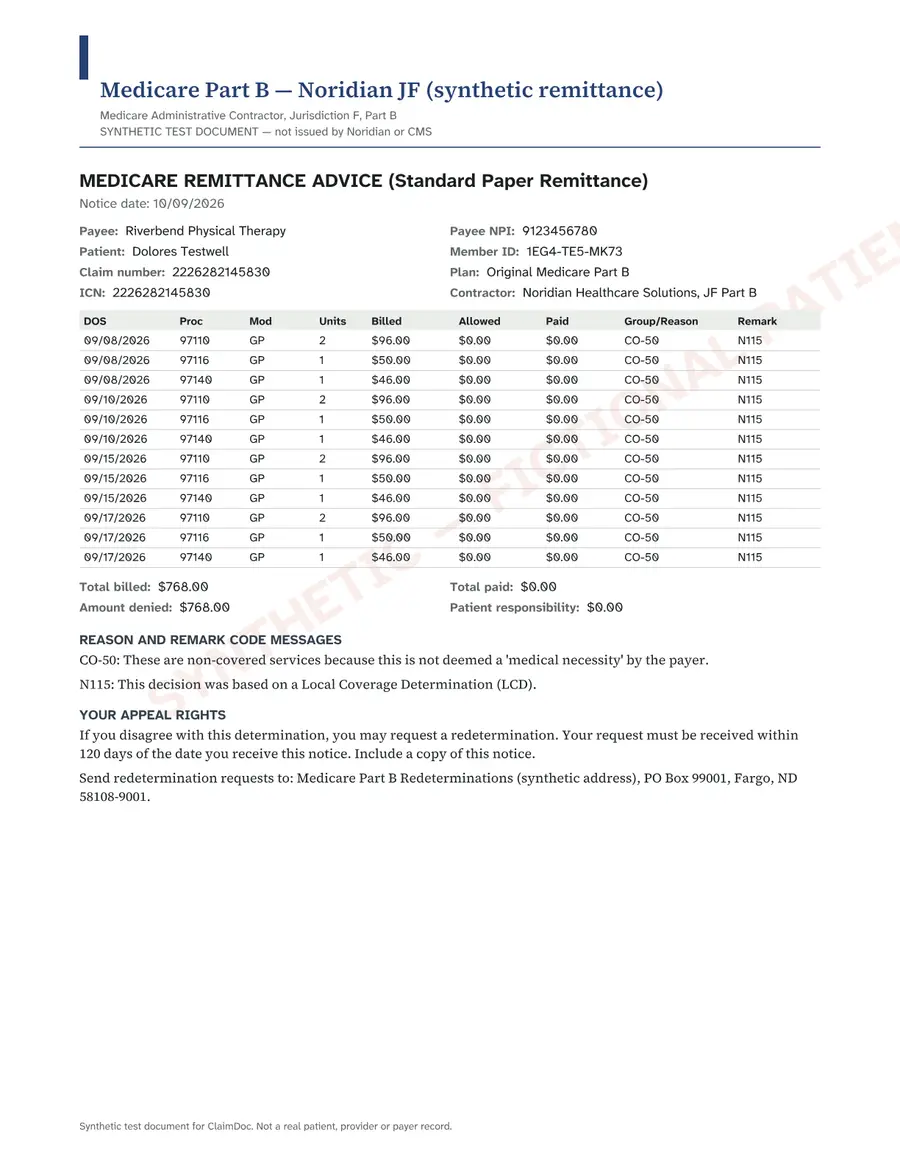
The denial

Original Medicare Part BClaim …5830

Denied$768.00

“Not deemed a medical necessity by the payer.” CO-50

The appeal ClaimDoc wrote

Request for Redetermination · page 2 of 4

Your record, the page it citesEx. 5, p. 1

Initial evaluation: the page with the quoted words marked
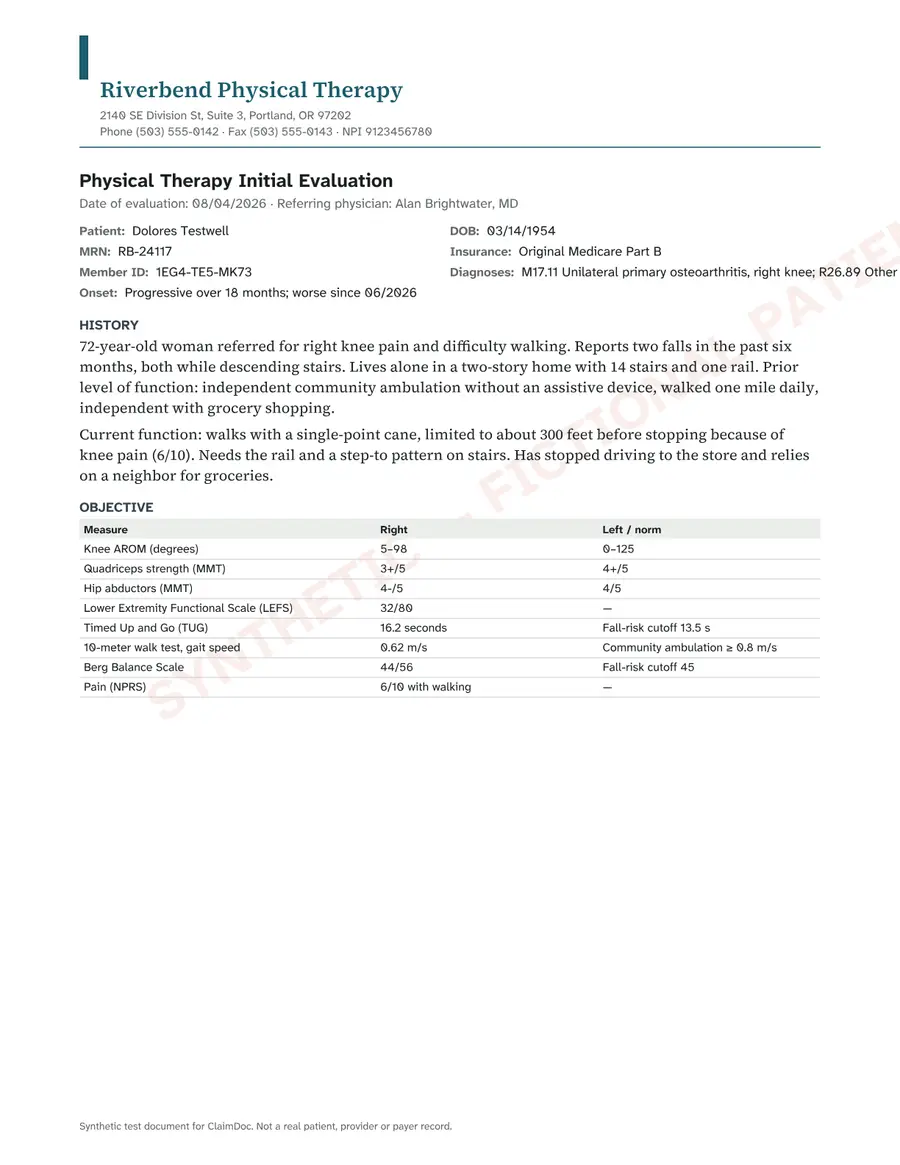
Quoted from Initial evaluation: Onset: Progressive over 18 months; worse since 06/2026 HISTORY 72-year-old woman referred for right knee pain and difficulty walking. Reports two falls in the past six months, both while descending stairs. Lives alone in a two-story home with 14 stairs and one rail. Prior level of function: independent community ambulation without an assistive device, walked one mile daily, independent with grocery shopping. Current function: walks with a single-point cane, limited to about 300 feet before stopping because of knee pain (6/10). Needs the rail and a step-to pattern on stairs. Has stopped driving to the store and relies on a neighbor for groceries. OBJECTIVE Measure Right Left / norm Knee AROM (degrees) 5–98 0–125 Quadriceps strength (MMT) 3+/5 4+/5 Hip abductors (MMT) 4-/5 4/5 Lower Extremity Functional Scale (LEFS) 32/80 —
  1. Read11 pages
  2. RouteAppeal
  3. Payer rules9 found
  4. Proof8 of 8 met
  5. Checked25 of 25
  6. Packet23 pages
Medicare denied $768.00 as not medically necessary. ClaimDoc read 11 pages, chose to appeal, found 9 payer rules, met 8 of 8 with pages from the record, traced 25 of 25 sentences to a source, and built a 23-page packet ready to send.

Most denials are never appealed. Many wouldn't survive one.

1 in 5
in-network claims denied by ACA Marketplace insurers in 2023.
<1%
of the claims those insurers denied were ever appealed.
81%
of appealed Medicare Advantage prior authorization denials were overturned in 2024, fully or in part.

Appeals go unfiled because each one takes hours: finding the payer's rule, digging the proof out of the chart, writing it up and assembling the exhibits before the deadline. ClaimDoc does that work for every denial you upload.

Sources: KFF, claims denials and appeals in ACA Marketplace plans, 2023; Medicare Advantage prior authorization, 2024.

You upload. ClaimDoc does the digging.

Five steps, each built on the one before. It only stops to ask when it needs something only your clinic has.

  1. Original Medicare Part B · $768.00 deniedRead
    Remittance advice
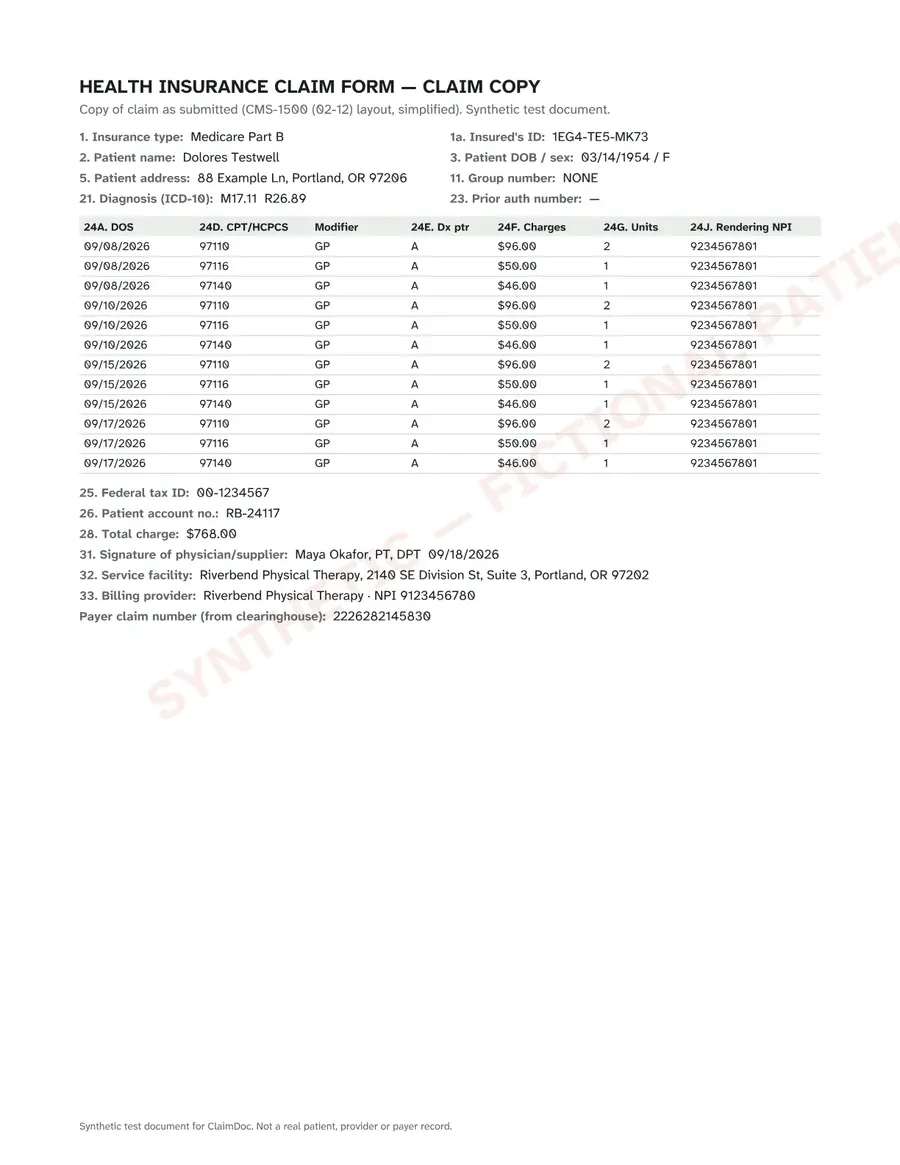
    Claim copy
    Plan of care
    Progress report
    Initial evaluation
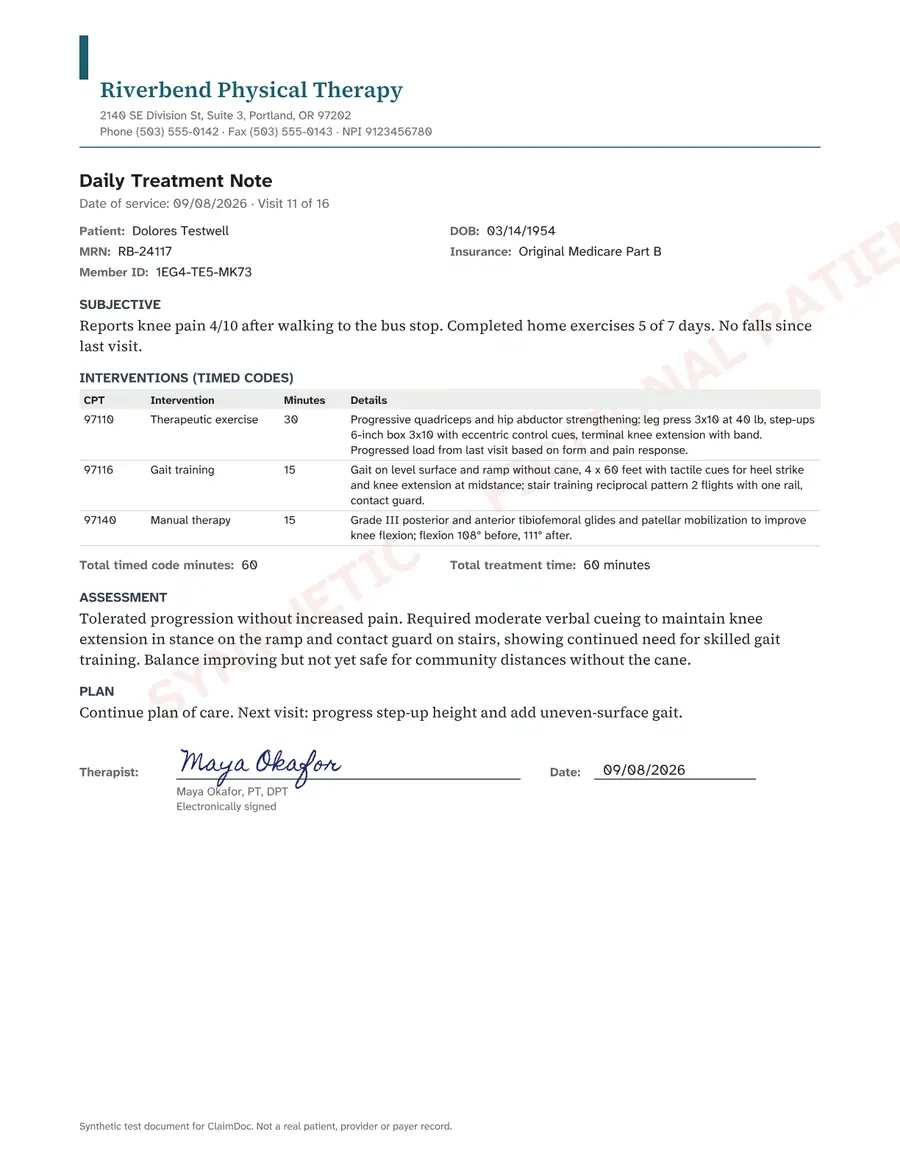
    Daily notes
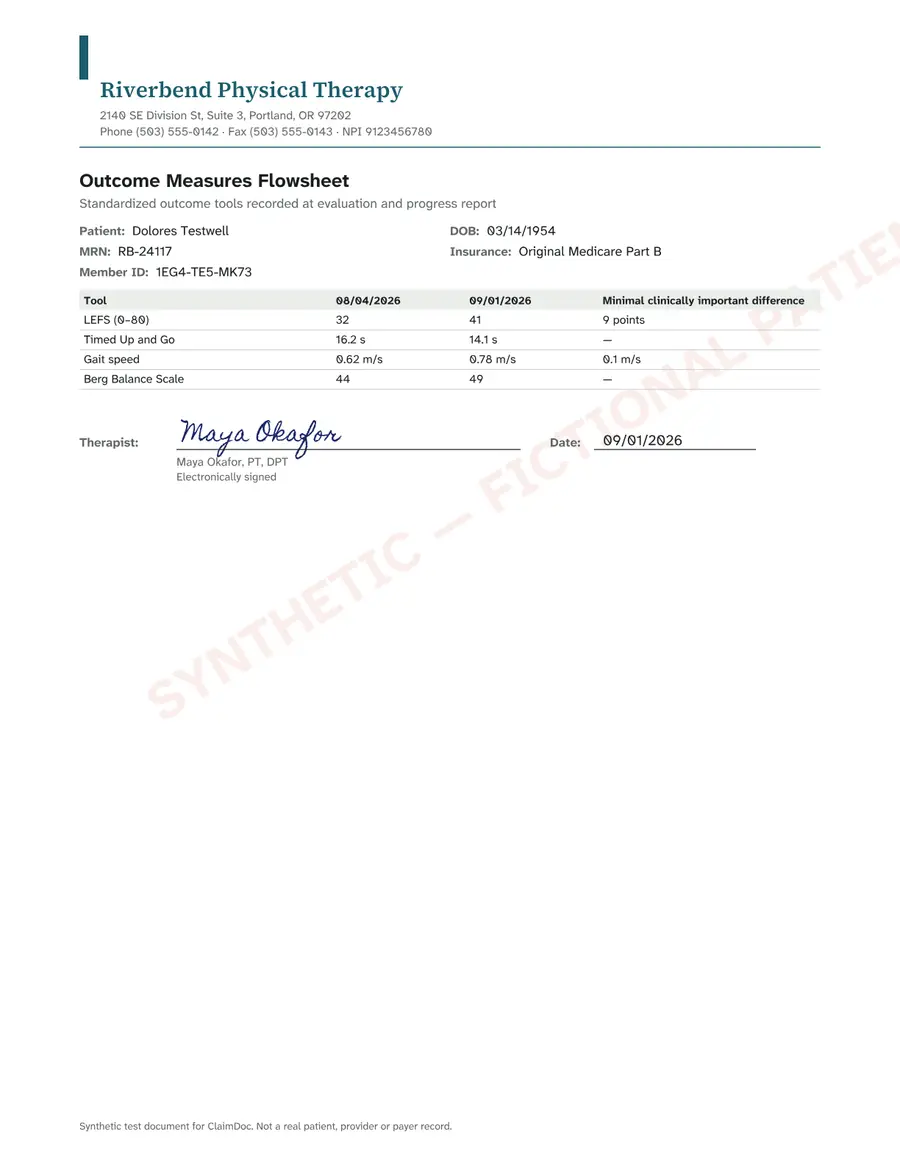
    Outcome measures

    11 pages read. Found the claim, the amount and the deadline: appeal by February 11, 2027.

    Upload what the payer sent, and the chart.

    The denial letter or remittance, plus the evaluation, plan of care and visit notes. Scans and phone photos work.

  2. Original Medicare Part B · $768.00 deniedTriage

    The payer said

    “Not medically necessary.”

    CO-50 · N115

    • AppealThe record can answer the payer's reason.
    • Corrected claimFor a billing or coding error.
    • Update insurance, resubmitWhen another plan should pay first.

    ClaimDoc picks the right fight.

    Some denials should be appealed. Others only need a corrected claim, and an appeal would be thrown out. It tells you which, in plain words, before any work is done.

  3. Original Medicare Part B · $768.00 deniedPolicy Index
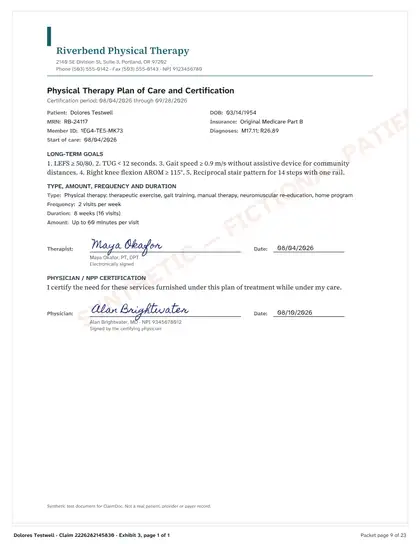
    • ···Written plan of care with the required elementsEx. 3, p. 1
    • ···Coverage doesn't depend on improvement (Jimmo)Ex. 4, p. 1
    • ···Plan of care certified by a physician or NPPEx. 3, p. 1
    • ···Services need a therapist's skillsEx. 6, p. 1
    • ···Restorative progress or skilled maintenanceEx. 5, p. 2
    • ···Evaluation with objective findingsEx. 5, p. 1
    • ···Progress report at least every 10 treatment daysEx. 4, p. 1

    8 of 8 payer rules met from 9 found, each with the page that meets it.

    It finds the payer's rules, and the proof in your chart.

    Every rule the payer applies is matched to the page of your record that meets it. If something is missing, it names the exact document that would fix it.

  4. Original Medicare Part B · $768.00 deniedVerification Gate

    0of 25 sentences traced to a source

    • At evaluation the patient walked with a single-point cane, was limited to about 300 feet by knee pain of 6/10, needed the rail and a step-to pattern on stairs, and reported two falls in the past six months while descending stairs.checking
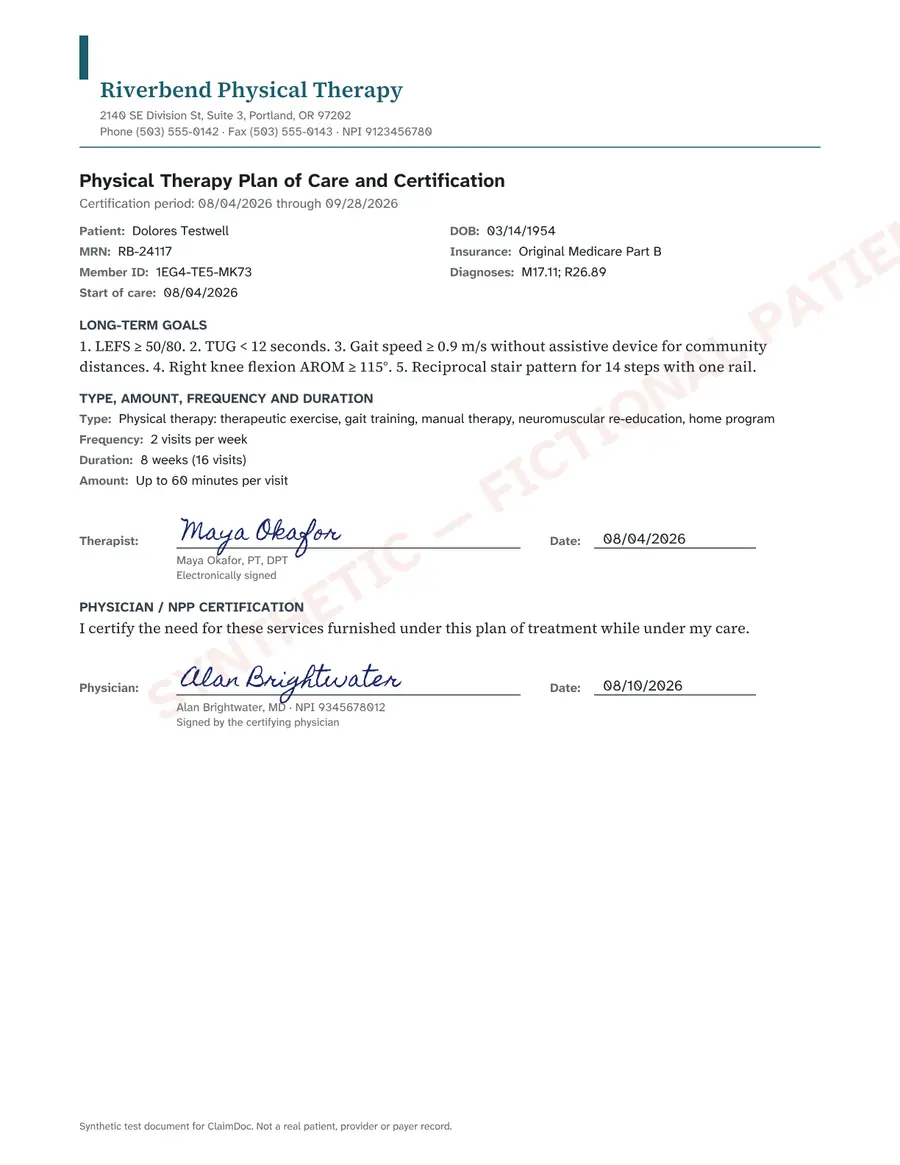
    • The plan of care carries the statement "I certify the need for these services furnished under this plan of treatment while under my care," signed by Alan Brightwater, MD, and dated 08/10/2026.checking
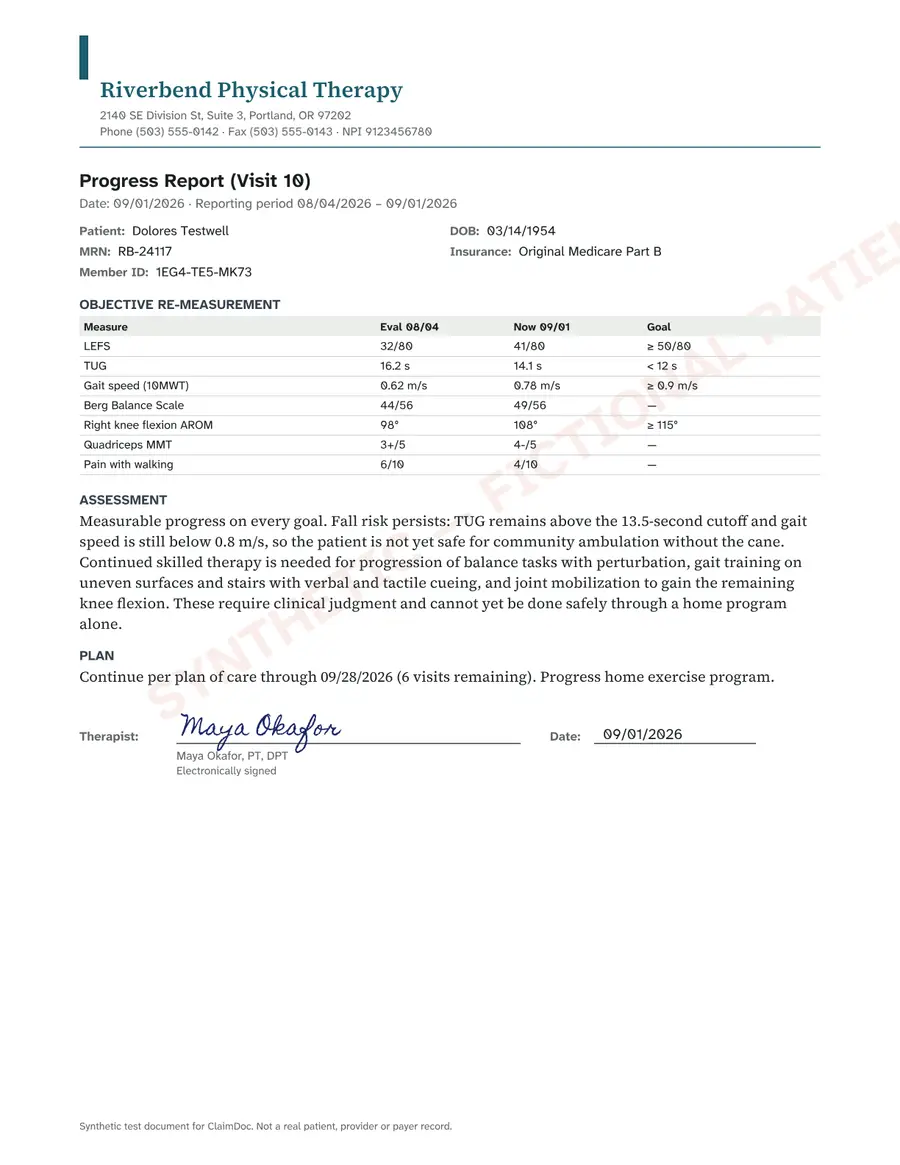
    • At the 09/01/2026 progress report, LEFS had improved from 32/80 to 41/80, TUG from 16.2 s to 14.1 s, and gait speed from 0.62 m/s to 0.78 m/s, and the therapist documented measurable progress on every goal.checking

    Dates, amounts and codes re-checked against the record. Nothing unproven leaves.

    Every sentence is checked before anything leaves.

    A second, independent check reads the letter against your records and the payer's policy, and re-checks every number and date. A sentence it can't prove doesn't go out.

  5. Original Medicare Part B · $768.00 deniedPacket
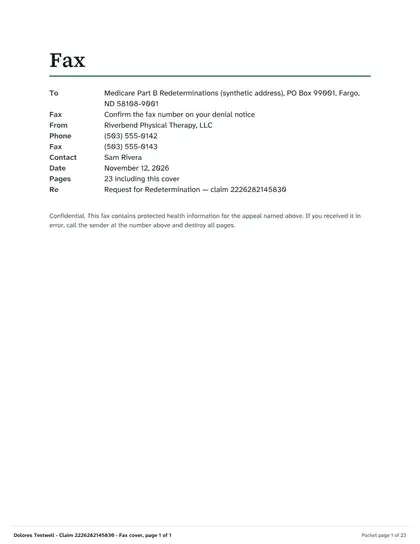
    Fax cover
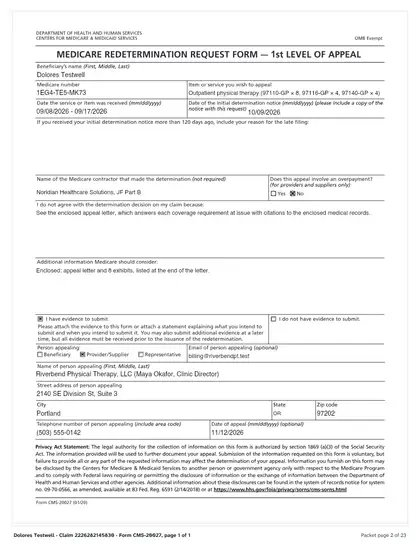
    Medicare's form
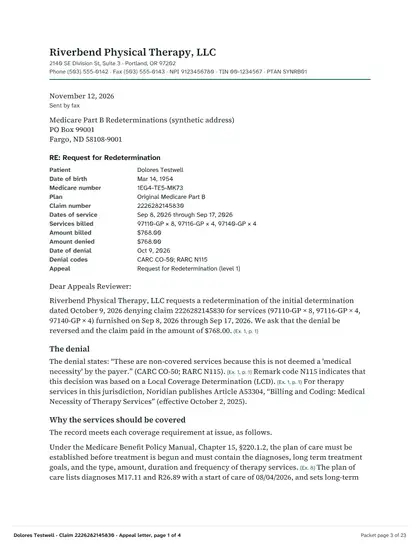
    Letter
    Exhibits
    Policy

    Ready to sendOne 23-page PDF, signature applied.

    You get one finished file, ready to send.

    The payer's own form filled in, the letter on your letterhead with your signature applied, and numbered exhibits. Fax it, upload it or mail it.

Open a finished appeal. Pick any sentence.

This is ClaimDoc's own screen, replaying a case from upload to packet. Pick a sentence and the page that proves it opens beside it, with the exact words marked.

Denied$768.00“Not medically necessary”Original Medicare Part B · Dolores Testwell · CO-50

The Workup is finished.

Read
11 pages
across 7 documents
Route
Appeal
Medicare's first-level appeal
Payer rules
9 found
from Medicare's own manual
Proof
8 of 8 met
1 more doesn't apply here
Checked
25 of 25
sentences traced to a source
Packet
23 pages
signed and ready to send
Show the 9 passes behind this result
  1. Read 11 pages across 7 documents
  2. Sorted documents by type
  3. Found the claim, the codes and the deadline
  4. Route: appeal (Medicare's first-level appeal)
  5. Pulled 9 requirements from Medicare's policy
  6. Matched 8 of 8 requirements to a page
  7. Drafted the appeal letter
  8. Cleared 25 of 25 statements against their sources
  9. Built the 23-page packet, signature applied
Ready to send

Select any sentence. Its source opens with the exact words marked.

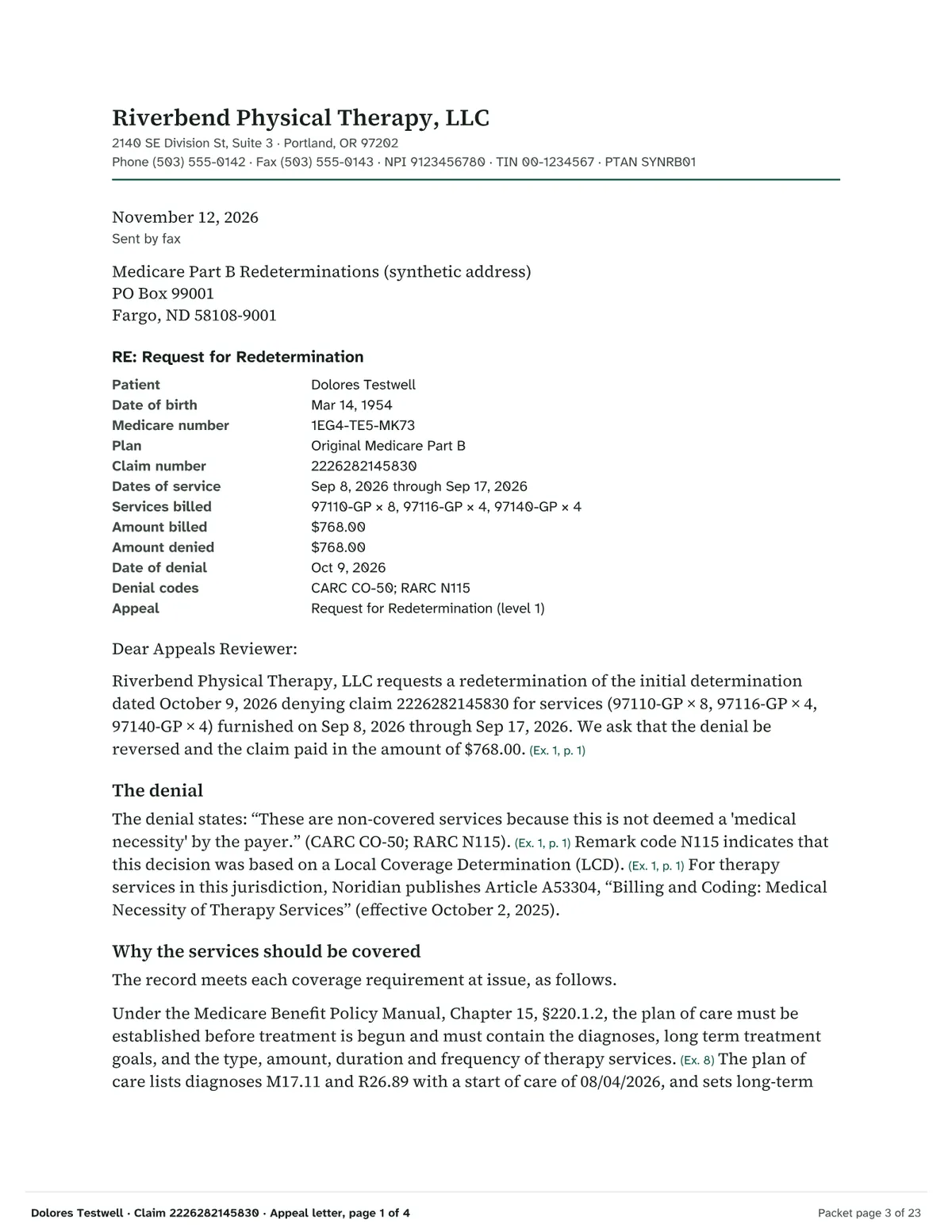
Riverbend Physical Therapy, LLC

2140 SE Division St, Suite 3 · Portland, OR 97202

Phone (503) 555-0142 · Fax (503) 555-0143 · NPI 9123456780

November 12, 2026

Medicare Part B RedeterminationsPO Box 99001Fargo, ND 58108-9001

RE: Request for Redetermination

Patient
Dolores Testwell
Date of birth
Mar 14, 1954
Medicare number
1EG4-TE5-MK73
Plan
Original Medicare Part B
Claim number
2226282145830
Dates of service
Sep 8, 2026 through Sep 17, 2026
Services billed
97110-GP × 8, 97116-GP × 4, 97140-GP × 4
Amount billed
$768.00
Amount denied
$768.00
Date of denial
Oct 9, 2026
Denial codes
CARC CO-50; RARC N115
Appeal
Request for Redetermination (level 1)

Dear Appeals Reviewer:

Riverbend Physical Therapy, LLC requests a redetermination of the initial determination dated October 9, 2026 denying claim 2226282145830 for services (97110-GP × 8, 97116-GP × 4, 97140-GP × 4) furnished on Sep 8, 2026 through Sep 17, 2026. We ask that the denial be reversed and the claim paid in the amount of $768.00.

The denial

The denial states: “These are non-covered services because this is not deemed a 'medical necessity' by the payer.” (CARC CO-50; RARC N115). Remark code N115 indicates that this decision was based on a Local Coverage Determination (LCD). For therapy services in this jurisdiction, Noridian publishes Article A53304, “Billing and Coding: Medical Necessity of Therapy Services” (effective October 2, 2025).

Why the services should be covered

The record meets each coverage requirement at issue, as follows.

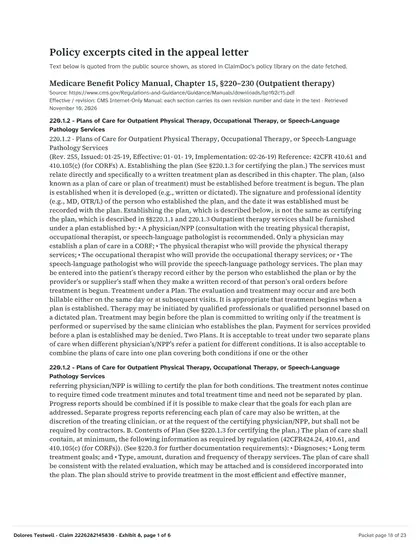
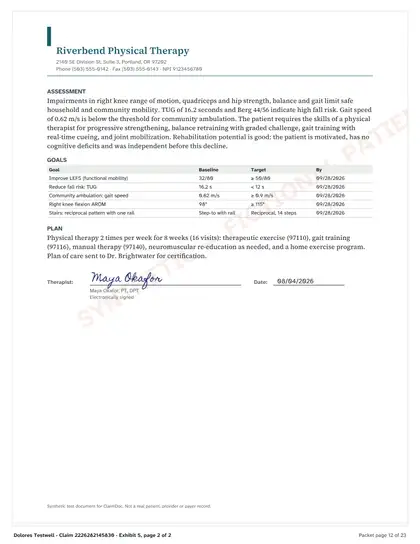
Under the Medicare Benefit Policy Manual, Chapter 15, §220.1.2, the plan of care must be established before treatment is begun and must contain the diagnoses, long term treatment goals, and the type, amount, duration and frequency of therapy services. The plan of care lists diagnoses M17.11 and R26.89 with a start of care of 08/04/2026, and sets long-term goals of LEFS ≥ 50/80, TUG under 12 seconds, gait speed ≥ 0.9 m/s without an assistive device for community distances, right knee flexion AROM ≥ 115°, and a reciprocal stair pattern for 14 steps with one rail. It specifies physical therapy consisting of therapeutic exercise, gait training, manual therapy, neuromuscular re-education and a home program, at 2 visits per week for 8 weeks (16 visits) and up to 60 minutes per visit, and it was electronically signed by Maya Okafor, PT, DPT, on 08/04/2026.

Under the Jimmo v. Sebelius settlement, coverage turns on the need for skilled care rather than potential for improvement, and the progress report documents that continued skilled therapy is needed for balance progression with perturbation, gait training on uneven surfaces and stairs with verbal and tactile cueing, and joint mobilization, which require clinical judgment and cannot yet be done safely through a home program alone.

Chapter 15, §220.1.3 requires a dated signature on the plan of care or other document indicating approval, and initial certification is timely when documented and dated in the 30 days following the first day of treatment, including evaluation. The plan of care carries the statement "I certify the need for these services furnished under this plan of treatment while under my care," signed by Alan Brightwater, MD, and dated 08/10/2026. The initial evaluation was performed on 08/04/2026 and documents that the plan of care was sent to Dr. Brightwater for certification.

Chapter 15, §220.2 requires services of such complexity and sophistication, or a patient condition such, that they can be safely and effectively performed only by a therapist or under a therapist's supervision. The treatment notes for 09/08/2026, 09/10/2026, 09/15/2026 and 09/17/2026 document Grade III posterior and anterior tibiofemoral glides with patellar mobilization to improve knee flexion, and gait and reciprocal stair training with tactile cues for heel strike and knee extension and contact guard on stairs. The therapist documented that the patient required moderate verbal cueing to maintain knee extension in stance on the ramp and contact guard on stairs, and the evaluation found that a TUG of 16.2 seconds and Berg of 44/56 indicate high fall risk.

Chapter 15, §220.2 requires that services be a specific and effective treatment for the patient's condition under accepted standards of practice, with reasonable amount, frequency and duration, and skilled therapy may be necessary to improve, maintain, or slow deterioration of the patient's condition. The evaluation rated rehabilitation potential as good because the patient is motivated, has no cognitive deficits and was independent before this decline, and set target dates of 09/28/2026 for the goals. At the 09/01/2026 progress report, LEFS had improved from 32/80 to 41/80, TUG from 16.2 s to 14.1 s, and gait speed from 0.62 m/s to 0.78 m/s, and the therapist documented measurable progress on every goal.

Chapter 15, §220.3 requires the initial evaluation to document the necessity for a course of therapy through objective findings and subjective patient self-reporting. The 08/04/2026 evaluation measured right knee AROM of 5–98 degrees, right quadriceps strength of 3+/5, LEFS of 32/80, TUG of 16.2 seconds against a fall-risk cutoff of 13.5 s, gait speed of 0.62 m/s against a community ambulation threshold of 0.8 m/s, and a Berg Balance Scale score of 44/56 against a fall-risk cutoff of 45. At evaluation the patient walked with a single-point cane, was limited to about 300 feet by knee pain of 6/10, needed the rail and a step-to pattern on stairs, and reported two falls in the past six months while descending stairs.

Chapter 15, §220.3 requires that progress reports be written by a clinician at least once every 10 treatment days. Maya Okafor, PT, DPT, wrote the Visit 10 progress report dated 09/01/2026, covering the reporting period 08/04/2026 to 09/01/2026. The report re-measured outcomes against the evaluation, including right knee flexion AROM from 98° to 108° against a goal of ≥ 115°, and the billed treatment notes are numbered Visit 11 of 16 through Visit 14 of 16.

Under Chapter 15, §220.3, contractors determine the necessity of services based on the delivery of services as directed in the plan and as documented in the treatment notes and progress report. Treatment notes electronically signed by Maya Okafor, PT, DPT, are in the record for the dates of service 09/08/2026, 09/10/2026, 09/15/2026 and 09/17/2026. Each note records therapeutic exercise for 30 minutes, gait training for 15 minutes and manual therapy for 15 minutes, with total timed code minutes of 60 and total treatment time of 60 minutes.

Clinical summary

The patient, age 72, was referred for right knee pain and difficulty walking with unilateral primary osteoarthritis of the right knee, reported two falls in six months, and had declined from independent community ambulation without an assistive device to walking with a single-point cane. By 09/01/2026 the patient had improved LEFS from 32/80 to 41/80, Berg Balance Scale from 44/56 to 49/56, and pain with walking from 6/10 to 4/10. Fall risk persisted, with TUG still above the 13.5-second cutoff and gait speed below 0.8 m/s, and during the billed visits the patient still required moderate verbal cueing and contact guard on stairs and was not yet safe for community distances without the cane.

For these reasons, we ask that you reverse the denial and pay the claim. If the denial is upheld, please identify the Local Coverage Determination applied (remark code N115), the specific provisions of it or of Article A53304 that these services are said not to meet, and the documentation you relied on. Please contact Sam Rivera at (503) 555-0142 ext. 2 with any questions.

Sincerely,

Signature of Maya OkaforSignature on file, applied automatically

Maya Okafor, PT, DPT

Clinic Director
Enclosures

  • Exhibit 1: Denial notice and remittance advice (1 page)
  • Exhibit 2: Claim as submitted (1 page)
  • Exhibit 3: Plan of care (1 page)
  • Exhibit 4: Progress report (1 page)
  • Exhibit 5: Initial evaluation (2 pages)
  • Exhibit 6: Treatment notes (4 pages)
  • Exhibit 7: Outcome measure scores (1 page)
  • Exhibit 8: Policy excerpts cited in this letter (6 pages)

Source trace

Where this comes from

    The patient and clinic are fictional. The work isn't: every finding, sentence and page above is exactly what ClaimDoc produced.

    One file. Ready for the fax machine.

    Nobody polishes it and nobody signs each one. It arrives in the order appeal reviewers expect, with your clinic's signature already applied.

    The payer's own form, filled in
    Medicare's appeal request, Cigna's review form, or the Medicare Advantage waiver of liability. Filled from the claim, never retyped.
    A letter on your letterhead
    It answers each reason for the denial, one by one. Every sentence names the exhibit and page behind it.
    Numbered exhibits
    Your records in the order the letter cites them, every page stamped with the claim number.
    The policy, quoted
    The exact rules the letter relies on, with where and when they were published.
    Everything around it
    A fax cover with the page count, bookmarks through the file, and a Word copy of the letter.

    Then send it your way. Fax, portal or mail. ClaimDoc keeps the deadline in view and records the outcome when the payer decides.

    It also knows when not to appeal.

    Appealing a billing error burns the deadline and gets dismissed. ClaimDoc reads the denial first and names the move that actually gets the claim paid. You can always overrule it.

    What the payer says, and the route ClaimDoc takes
    The payer saysClaimDoc's moveCode
    “Not medically necessary”AppealAnswer the payer's rules point by point, with proof from the chart.CO-50
    “No prior authorization on file”AppealSend the approval and its number.CO-197
    “Something on the claim is missing”Fix the claimSend a corrected claim. An appeal would be dismissed.CO-16
    “Another insurer should pay first”Update insuranceCorrect the coordination of benefits, then resubmit.CO-22
    “Looks like a duplicate”Check firstFind the earlier claim, then correct it or ask for a reopening.CO-18
    “Visit limit reached”Usually stopAppeal only where the plan has an exception path.CO-119

    Tested on the denials therapy clinics see most.

    Eight denial types across Medicare, Medicare Advantage, Aetna, Cigna and UnitedHealthcare, each run from upload to finish.

    8 of 8
    denials ended in the right place: a finished appeal, a stop to ask for a missing record, or a different route.
    147 of 147
    sentences in the finished letters traced to a page of the record or the payer's policy.
    4 of 6
    appeal packets built with no questions asked. The other two each asked one: how the appeal would be submitted.
    The eight test denials and what ClaimDoc did with each
    The denialWhat should happenWhat ClaimDoc did
    MedicareTherapy “not medically necessary”Should: Appeal on Medicare's formReadyReady to send. No questions asked. 25 of 25 sentences sourced.
    MedicareOver the yearly therapy limit, billed without the code that says it's needed (KX)Should: Add the code, with proof the therapy was neededReadyReady to send. No questions asked. 30 of 30 sourced.
    Medicare AdvantageClinic outside the plan's networkShould: Appeal, plus a signed waiver of liabilityReadyReady to send, waiver signed. No questions asked. 26 of 26 sourced.
    CignaNo prior authorization, though the approval was on fileShould: Appeal on Cigna's formReadyReady to send, form filled and signed. No questions asked. 12 of 12 sourced.
    Aetna“Not medically necessary”, with a scanned evaluationShould: Appeal against Aetna's own policyReadyReady to send after one question: how it would be submitted. 33 of 33 sourced.
    AetnaInstructions planted inside a clinical noteShould: Treat the note as a record, never as ordersReadyReady to send after one question: how it would be submitted. None of the planted text reached the letter. 21 of 21 sourced.
    MedicareThe physician never signed the plan of careShould: Stop and name the gapStoppedStopped, and named the unsigned plan of care.
    UnitedHealthcareClaim sent with information missingShould: No appealRoutedRouted to a corrected claim.

    Internal test run, November 12, 2026. Each case was built to match a real denial type; no real patient data was used.

    Built for records that aren't yours to lose.

    Patient records are handled only under a signed business associate agreement, and protected the same way everywhere they go.

    Clinic Walls
    No clinic can see another clinic's cases. The separation is built into the foundation, not only the screens.
    Sealed Records
    Files stay private, open only for the right person, and access never lingers. Patient details stay out of links, logs, analytics and email.
    The Ledger
    Every view, export, change and applied signature is recorded where your owners can read it, and nobody can edit the record.
    Verification Gate
    Nothing unproven leaves. Every sentence is checked against its source before a packet exists.

    How ClaimDoc protects recordsSubprocessors

    Questions clinics ask first.

    Something else? Write to hello@claimdoc.co and a person answers.

    Do we have to review or sign each appeal?
    No. The Verification Gate is the check: a sentence that can't be traced to your records doesn't go in the letter. You set up the clinic's signature once, and ClaimDoc applies it wherever a form or letter needs one, including the Medicare Advantage waiver of liability. Your clinic is still the one sending the appeal, so, as with a letter you write yourself, it stays responsible for what goes to the payer.
    Is the letter written by AI?
    The argument is. ClaimDoc reads your records and drafts the reasons the denial is wrong, and it can only write statements it ties to a page in your records or a passage of published policy. A second, separate check then rejects anything it can't prove before a packet exists. The letterhead, claim details, request and closing are filled in from your claim.
    What happens when the records are missing something?
    ClaimDoc stops and names it in plain words, for example “The plan of care has no physician signature date,” along with what fixes it. Add the record and the case finishes on its own, or send without that point and the letter leaves it out. It never writes around a gap.
    Which payers and plans does it work with?
    Original Medicare, Medicare Advantage, and commercial and employer plans. The Policy Index holds published policy for Medicare, Aetna and Cigna, and grows every month. Where a payer's policy isn't in the Index yet, the letter argues from the governing rules and asks the payer for the criteria it used. Medicaid plans work when you confirm the deadline from the notice. Workers' compensation and auto claims aren't supported, and ClaimDoc says so when it sees one.
    Who is it for?
    Physical therapy clinics first, with occupational therapy, speech and chiropractic next. The front desk uploads from a scanner or a phone, and the clinic's letterhead, signature and payer networks are set once. Billing teams get one sign-in for every clinic they serve, each clinic's cases kept apart, and one view of every open appeal by deadline.
    How is patient data protected?
    Patient records are handled only under a signed business associate agreement with your clinic, and with every provider that stores or processes them. Clinics are walled off from each other, files stay private, and every action is recorded. The security page explains how, and a detailed security packet is available on request.
    Does ClaimDoc send the appeal to the payer?
    You get one PDF and a Word copy of the letter, and you send it the way you do today: fax, portal or mail. ClaimDoc keeps the deadline in front of you and records the outcome when the payer decides.
    What if something in a letter is wrong?
    Correct the claim detail or add the right record, and ClaimDoc rebuilds the letter and checks it again before a new packet is made. The Word copy is there if your clinic ever wants different wording; changes made there are yours.
    Does it work from a phone?
    Yes. Photograph the denial and the records and upload them from the same screen. ClaimDoc reads photos and scans as well as typed pages.
    What does it cost?
    It's free to start, with no card to enter. Pricing will be published before anything is ever charged.

    The next denial is already in the mail.Have the proof ready.

    Start free

    Free to start, no card. Set your clinic up once, then upload a denial.